

You can have the best-looking website in your industry. Fast load times, beautiful photography, five-star reviews plastered across every page. And still watch potential customers drift off to a competitor, or disappear back to a third-party booking platform, without ever taking the action you actually wanted them to take.
The reason, more often than not, is simple: nobody told them what to do next.
Effective calls to action (CTAs) are one of the most underestimated conversion levers available to any business with a website. Not just a button here and there, but a deliberate, strategic approach to guiding your visitor towards a specific outcome at every stage of their journey. Get it right and your website stops being a digital brochure and starts working as a genuine sales tool.
What Is a Call to Action, and Why Does It Matter?
A call to action is any element on a page that prompts a visitor to take a specific next step. That might be booking a table, requesting a quote, downloading a guide, signing up for a newsletter, or picking up the phone. It can be a button, a banner, a pop-up, a sticky bar, or a section of copy. The format is less important than the principle: you are removing friction and giving the visitor a clear, obvious path forward.
The problem most websites have is not a lack of CTAs entirely. It is that their CTAs are buried, vague, inconsistent, or positioned at entirely the wrong moment in the user journey. “Contact us” at the very bottom of a page, in grey text, after three paragraphs about your company history, is technically a CTA. It is not, however, doing much heavy lifting.
Effective conversion rate optimisation (CRO) starts with understanding the intent of your visitor at any given moment, and then meeting them there with an action that makes sense.
The Book Direct Problem: A Real-World Example
One of the clearest illustrations of this challenge sits in the hospitality sector, and it is one we have been working on directly with our client The Lamplighter Dining Rooms in Windermere.
The Lamplighter is a restaurant and rooms offering that attracts visitors actively researching accommodation and dining in the Lake District. Like most hospitality businesses, they face a specific and expensive problem: potential guests find them through Google, arrive on their website, and then drift back to Booking.com or another OTA (online travel agency) to complete their reservation.
The OTA takes a commission of anywhere between 15% and 25%. The hotel loses margin. The guest often ends up paying more. Everyone loses except the middleman.
The solution is not just about having a “Book Now” button somewhere on the homepage. It is about giving the visitor a persistent, compelling reason to book direct, at every touchpoint, throughout their entire session on the site.
For The Lamplighter, we built a prominent pull-out panel that slides in consistently across all pages of the website. It does several things at once:
- It is always visible, regardless of which page the visitor is on or how they arrived. Someone jumping between the menu page, the rooms page, and a blog post will see it every time.
- It presents a clear value proposition, not just a button. The panel lists the specific benefits of booking direct: lowest rate guaranteed, no up-front payment, free cancellation, a flat-rate dog fee rather than a per-night charge, inclusive breakfast, and exclusive rates only available through the site.
- It removes the reason to go elsewhere. A visitor who was about to open a new tab for Booking.com is confronted with a direct answer to the question “why would I book here instead?”
The result is a CTA that works precisely because it understands the visitor’s likely behaviour and intercepts it at the right moment, with the right information.
The Principles Behind High-Converting CTAs
Whether you are running a hotel, a B2B service business, a trades company, or an e-commerce brand, the same principles apply.
1. Be specific about the benefit, not just the action
“Get in Touch” tells your visitor what you want them to do. “Get a Free Quote in 24 Hours” tells them what they will get. The second version removes uncertainty and reduces the risk of clicking feeling like a commitment. Wherever possible, lead with outcome.
2. Reduce friction at the point of decision
If your CTA links to a lengthy form, a slow-loading page, or a process that requires four steps before the visitor gets any value, you will lose people at the transition. The click is the easy part. What happens immediately after the click matters just as much.
3. Place CTAs where intent is highest
A visitor reading a detailed service page is more likely to convert than one who has just landed on your homepage for the first time. Map your CTAs to intent. Your most direct “buy” or “book” CTAs belong on pages where the visitor already knows what you do and is weighing up whether to proceed.
4. Use persistent or sticky elements for high-priority actions
For any business where a single conversion has significant value, whether that is a hotel booking, a kitchen installation enquiry, or a commercial contract, a sticky bar, persistent pop-up, or slide-in panel is worth serious consideration. The Lamplighter’s book direct panel is a good example: it does not demand attention, but it is always available. The visitor does not need to scroll back to the top or hunt for the booking link.
5. Test, measure, and iterate
A CTA that works brilliantly in one context may underperform in another. The only way to know is to measure. At a minimum, set up goal tracking in Google Analytics or your equivalent platform so you can see which pages are generating conversions and which are leaking visitors. Then test variations: different copy, different placement, different colours, different incentives.
Landing Pages Are Not Exempt
Much of the CTA conversation focuses on websites, but the same logic applies with even greater urgency to paid advertising landing pages.
When someone clicks a Google Ad or a paid social post, they arrive with a very specific intent signal. They were searching for something, or they responded to a message aimed at their interests. The landing page has one job: convert that intent into an action. Every element on the page that does not serve that conversion is, in effect, competing against it.
A landing page with a weak or unclear CTA is money poured into a leaky bucket. Every pound spent driving traffic is partially wasted if the visitor arrives and then has no obvious, compelling next step. Clarity, relevance, and a single focused action are the hallmarks of a landing page that earns its media budget.
What Good CTA Strategy Looks Like in Practice
For most businesses, a properly considered CTA strategy involves:
- Auditing your existing pages to identify where visitors are dropping off and where CTAs are absent or poorly positioned
- Defining the one primary action you want each page to drive, and building the page around that action
- Writing CTA copy that leads with benefit and removes uncertainty
- Implementing persistent elements (sticky headers, slide-in panels, exit-intent pop-ups) for your highest-value conversions
- Setting up proper conversion tracking so you can measure what is actually working
It is not complicated in principle. But it does require stepping back from the assumption that having a website is enough, and recognising that a website without a clear conversion strategy is simply an expense rather than an asset.
Working With Us
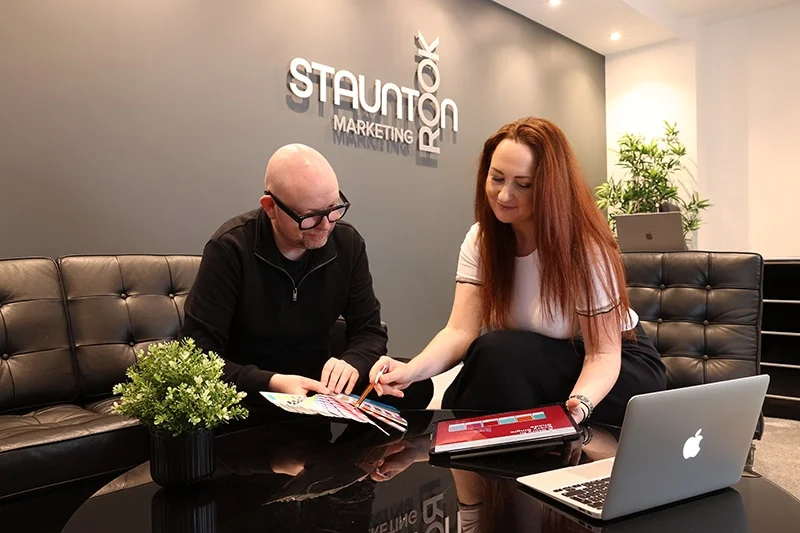
At Staunton Rook, conversion strategy is built into every website and campaign we produce. From the book direct panel we built for The Lamplighter Dining Rooms to the enquiry funnels we develop for our commercial clients, we approach every digital touchpoint with the same question: what do we want this visitor to do next, and are we making it as easy and compelling as possible for them to do it?
If your website is generating traffic but not converting, or if you are running paid advertising and unsure whether your landing pages are doing justice to your budget, we would be happy to take a look.
Staunton Rook is a Chester-based digital marketing and web design agency with over 25 years of experience working with businesses across the UK. We specialise in strategy-led digital marketing, paid advertising, SEO, and website design.