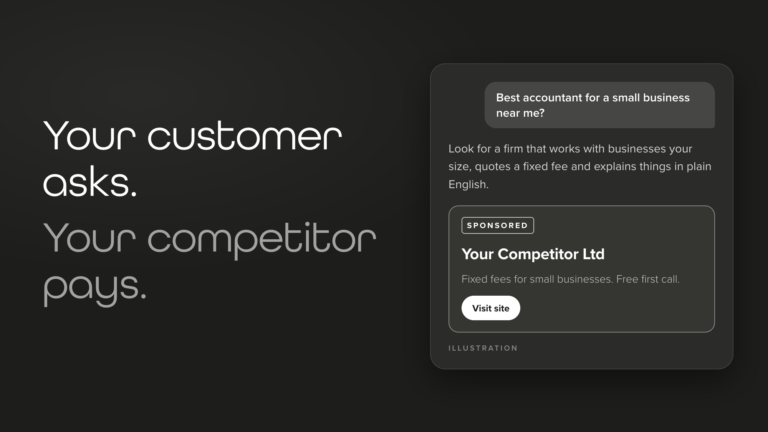
If your Facebook ads cost more this month than they did in October, you are not imagining it, and it is probably nothing you did wrong. Every year the price of showing an ad on Facebook and Instagram climbs in the weeks around Black Friday, which this year is on Friday 27 November 2026.
The short answer: in 2025 the median brand paid 84% more to reach 1,000 people on Black Friday than it did in September, and 59% more across Black Friday week. The rise starts to show in mid November and falls away after Cyber Monday. This post covers why it happens, what the data says, what we are seeing across the campaigns we run, and what it means for a UK business, whether or not you are running a sale.
Last updated 15 November 2026.
Why do Facebook and Instagram ads cost more around Black Friday?
Facebook and Instagram ads are both sold by Meta, through an auction. Shops, brands and service businesses all bid for the same people in the same feeds, and when more of them want those people at once, the price goes up. Black Friday is the busiest week for that competition, so it is when the price of reaching people climbs the most.
What is CPM in advertising?
CPM is the cost of showing your ad 1,000 times. To work it out, divide what you spent by the number of times the ad was shown, then multiply by 1,000. If you pay £50 and your ad is shown 10,000 times, your CPM is £5.
It is the price of reaching people, not the price of winning a customer. That difference matters later in this post.
How much do Facebook ads cost on Black Friday?
The most useful public data we found comes from Lebesgue, a company that sells analytics to online shops. It looked at the median brand among the biggest Meta advertisers in its data, covering $22.6 million of Meta spend between September and November 2025, and compared each day’s CPM with September. Meta ads means Facebook and Instagram together, so this is how the cost of reaching 1,000 people moved on both.
| 2025 | Cost to reach 1,000 people, compared with September |
|---|---|
| Early November | Within 7% |
| Week of 10 November | 15% higher |
| 20 November | 27% higher |
| 27 November (US Thanksgiving, the day before Black Friday) | 53% higher |
| 28 November (Black Friday) | 84% higher |
| 1 December (Cyber Monday) | 71% higher |
| 3 December | 20% higher |
Black Friday week as a whole averaged 59% higher. The same week in 2024 was 80% higher, so last year’s rise was smaller, but still large.
Two things stand out. The rise is not a single jump on the day. It builds through the second half of November and peaks on Black Friday itself. And it falls quickly afterwards, although it was still 20% above September on 3 December.
A second dataset points the same way. The advertising agency Gupta Media publishes a tracker of Meta ad costs. For 2024 it shows Black Friday at $16.85 per 1,000 views and Cyber Monday at $17.70, the most expensive day of the year, against an annual average of $7.43. The week that included Black Friday was the most expensive week of 2024, and the weeks directly before and after it were 12% to 27% cheaper. Which day is the peak changes from year to year, but the pattern of a steady climb and a sharp drop is the same.
How far can you trust those numbers?
With care. Lebesgue does not say how many brands are in its sample or which countries they sell in, the spend is in US dollars, and the categories it lists are all retail: home and decor, electronics, fashion and beauty. It also says its groups are small and not market wide benchmarks. Brands varied a great deal, from 51% lower to 172% higher in Black Friday week. Gupta Media’s tracker does not list the countries it covers either.
So treat this as the shape and timing of the rise, not a forecast of what you will pay in Chester.
What is different about 2026?
Prices were already higher before November began. Birch, which tracks Facebook ad costs, found that US campaigns averaged $21.45 per 1,000 views in October 2026, against $15.93 in October 2025. That is about 35% higher (reported in AdMake’s November 2026 round up of Meta changes). Birch’s figures cover US campaigns only.
Northbeam, another analytics company, expects the cost of winning new customers to rise over Black Friday and stay high through Christmas. Not everyone agrees on how long it lasts. Farhad Divecha of the agency Accuracast told Marketing Brew that the very highest prices come down after the holidays, and that some advertisers who skip the November rush are looking at the weeks after Christmas instead.
What are we seeing in our own campaigns?
We run a wide range of Meta campaigns for UK clients, including healthcare providers, so we can check the pattern against real data. Across all of them we are seeing the same thing: the cost of showing an ad 1,000 times has been rising since early November. The clearest example is a health screening campaign, because it kept the same audience and targeting throughout. The cost of showing its ad 1,000 times was 37% higher on Saturday 14 November than on Monday 9 November. On Sunday 15 November, with the day still in progress, it was 59% higher.
That is earlier and steeper than last year’s median in Lebesgue’s data. Our starting point is 9 November rather than September, but last year’s prices in early November were within 7% of September, so the comparison is fair enough to be useful. It also fits Birch’s finding that costs were already running above last year.
The likeliest explanation is retailers bidding for the same Facebook and Instagram audiences, even though a health screening has nothing to do with Black Friday. We cannot prove the cause from our own data alone, and a day that is part way through can look different by the evening, so treat the figures as a warning sign rather than a finding. The point for any business without a sale is that you do not have to take part in Black Friday to pay for it.
Does a higher cost mean Facebook and Instagram ads are not worth it on Black Friday?
Not necessarily, and this is the part of the Lebesgue analysis that gets missed. In Black Friday week 2025 the median brand paid 59% more to reach 1,000 people, yet its cost per purchase fell 20% and the return Meta reported on its ad spend rose 19%. More of the people who clicked went on to buy, with the share of clicks that ended in a purchase 48% higher than in September. Lebesgue’s conclusion is that CPM measures the price of reaching people, not whether you made a profit.
That lift comes from shoppers who are actively looking for deals. If you sell a service, a treatment or a health check, people are not shopping for it in the same way on Black Friday, so you may pay the higher price without getting the buying boost. That is our reading rather than something the data proves, and it is why we would judge a campaign by what it costs to get an enquiry, not by CPM.
What should a UK business do about it?
These are the five things we would do.
1. Judge the campaign by cost per enquiry or sale
Before November gets busier, work out the most you can pay for an enquiry or a sale and still make money. Then compare what you are really paying with that figure, not with the cost of reach. Our post on how to read the return on your Meta ad spend explains how to look at it.
2. Do not cut the budget by reflex
Lebesgue’s advice is that a higher CPM is a prompt to check your funnel, not a reason to cut spend on its own. If your cost per enquiry is steady, the campaign may still be earning its place. If it has climbed, look at the advert and the page people land on before you touch the budget.
3. Change one thing at a time
Prices will keep moving for the next few weeks, so a campaign can look better or worse from one day to the next. Keep the audience and the offer steady and change one thing at a time, otherwise you will not know what caused a change.
4. Check the page people land on, and your tracking
When each visitor costs more, a slow page or a broken form wastes more of your money. Check that your website loads quickly on a phone, that the enquiry form works and that your tracking records an enquiry when one comes in. If you are not sure, our web support team can check it for you.
5. Think about timing, and about where else to be
If your offer does not depend on November, you have a choice about when to spend. We would not assume a neat drop on a particular date, because the forecasts differ, but the 2025 data shows prices falling sharply after Cyber Monday.
It is also worth remembering that Facebook and Instagram show your advert to people while they scroll. Google Ads shows it to people who are already searching for what you offer. If that describes your service, our Google Ads agency in Cheshire page explains how we run it, and our free Google Ads audit shows where an account is losing money.
Plan earlier next year
In 2024 prices were already at least 10% above September by 14 October, so the quieter weeks before the rush are the time to test your adverts while reach is cheaper. Lebesgue recommends having your offers, adverts, landing pages and tracking ready by late October.
If you would like a second opinion on your Facebook and Instagram ads, our Meta ads agency team can look at your account and tell you what we would change. If you are deciding whether to join Black Friday at all, our earlier post on Black Friday strategies that work when everyone is early covers that.
Facebook ads and Black Friday: questions answered
Do Facebook ads cost more on Black Friday?
Yes. In Lebesgue’s 2025 data, the median brand paid 84% more per 1,000 views on Black Friday than in September, and 59% more across Black Friday week. The same week in 2024 was 80% more. Individual brands varied a lot, from 51% less to 172% more. A separate tracker from Gupta Media found Black Friday 2024 at $16.85 per 1,000 views, against an annual average of $7.43.
Why are Facebook ads so expensive in November?
Meta sells ad space in an auction, so when more businesses want the same people at the same time, the price goes up. November is when many retailers push hardest for Black Friday, and businesses without a sale pay the higher price too. We can see it across the campaigns we run, but we cannot prove the exact cause from our own data alone.
Do Instagram ads cost more on Black Friday?
In general, yes. Facebook and Instagram ads are bought through the same Meta system, and the figures in this post cover Meta ads as a whole, so they apply to both. We have not found separate Instagram only figures for Black Friday.
When do Meta ad costs start to rise before Black Friday?
In 2025, early November was within 7% of September, the week of 10 November was about 15% higher and 20 November was 27% higher. In 2024 the rise started earlier, with prices first reaching at least 10% above September on 14 October.
When do Meta ad costs come back down?
In 2025 they fell quickly after Cyber Monday, from 71% above September on 1 December to 20% above on 3 December, but they had not fully returned to normal. For 2026 the forecasts differ. Northbeam expects costs to stay high through Christmas, while the agency Accuracast says the peak prices fall back after Christmas.
Should I pause my Facebook and Instagram ads over Black Friday?
Not automatically. A higher cost to reach people does not tell you whether a campaign is still paying off. Work out what an enquiry or a sale costs you now and compare it with the most you can afford to pay. If it is still within that limit, the campaign may be worth keeping. If it is not, look at the advert and the page people land on before you touch the budget.
Does Black Friday affect my ads if I am not running a sale?
It can. You bid in the same auction as every business that is. Across the campaigns we run, costs have been rising since early November. In one health screening campaign, which has nothing to do with Black Friday, the cost of showing the ad 1,000 times was 59% higher on 15 November than on 9 November, with no change to the targeting. We cannot prove the cause from our own data, but it is a sign that businesses without a sale still feel the rise.
Sources
- Lebesgue, Are Meta ads worth it on Black Friday? CPM and ROAS data, 2025 figures, posted 16 October 2026.
- Gupta Media, the true cost of social media ads, 2024 Black Friday and Cyber Monday figures, page updated December 2025.
- AdMake, Meta Ads Updates November 2026, for the Birch and Northbeam figures.
- Marketing Brew, media buyers navigating higher ad prices on Meta, 8 October 2026.
- Meta, Facebook ad auctions explained.
- Staunton Rook data from the Meta campaigns we run for UK clients, with one health screening campaign as the worked example, 9 to 15 November 2026.
Staunton Rook is a full-service marketing agency based in Chester, working with businesses across the UK.