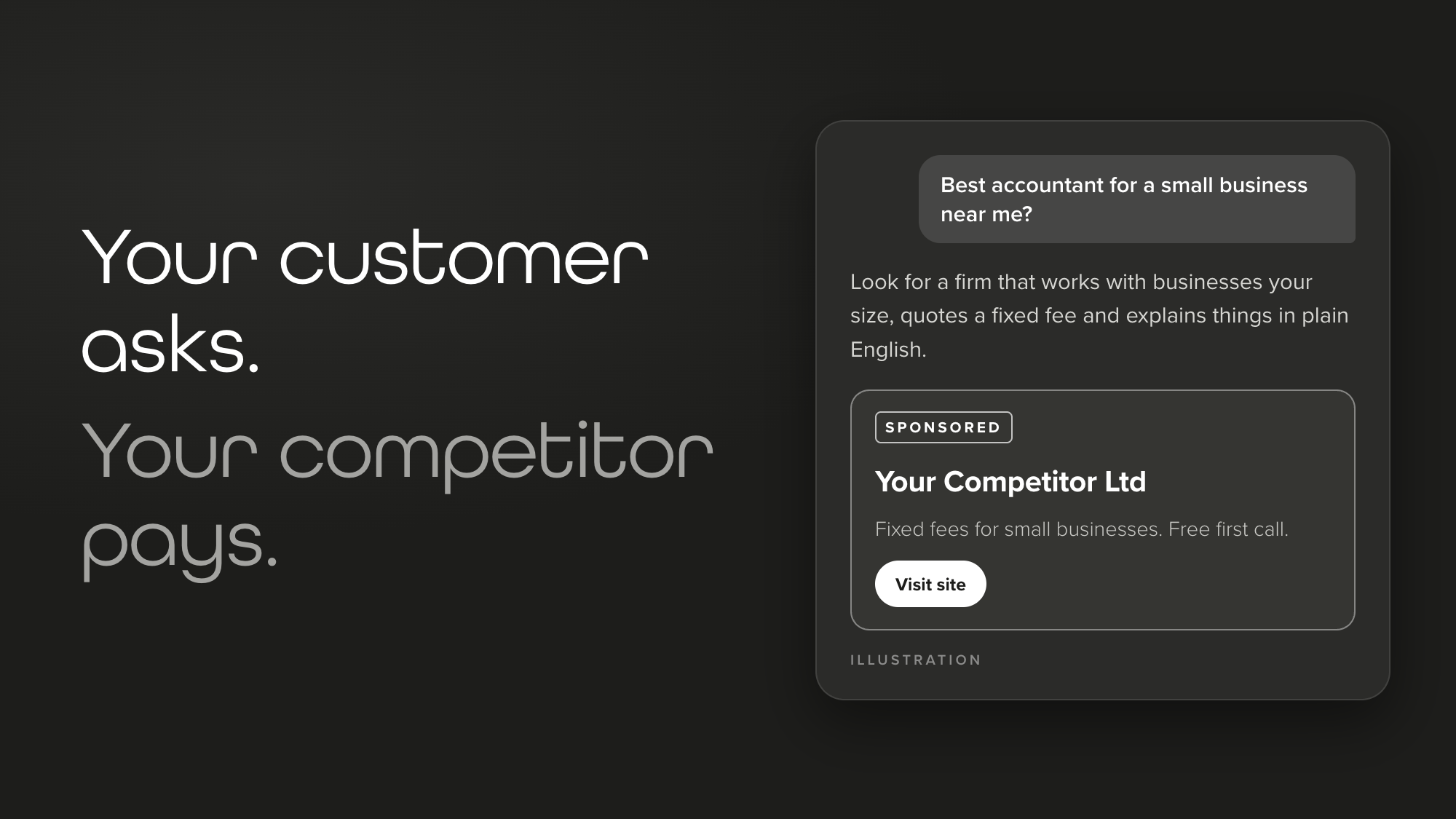
Picture someone who needs exactly what you sell. They ask Google a question about it. A few years ago they would have got a list of websites, and yours would have been on it. Now they get an answer written by Google, they read it, and they move on. They never visit your site. You did nothing wrong. The click just never happened.
That is already happening, and the numbers are ugly. When Google shows an AI answer, people click on a normal search result about half as often (more on that number below). You could call that theft. Google would call it a better answer.
Now comes the second blow. Google AI Mode ads are coming to the UK before the end of this year: Google has told advertisers it will put ads inside those AI answers. So when your customer asks that question, a competitor can pay to appear in the answer they are reading, with the word Sponsored beside them.
I don’t think this is a disaster, and there is no button to press this week. But if Google brings you customers, it is worth ten minutes of your time, because it changes what you are paying for when you pay for search. Here is what has been announced, what AI answers have already done to clicks, what I think it means, and what I would do about it.
What Google has actually announced
On 28 October, Google said it is scaling ads in AI Mode to ten more countries: Australia, Canada, India, Kenya, Malaysia, New Zealand, Nigeria, Pakistan, the Philippines and Singapore. In the US it has gone a step further and started showing ads on follow-up questions, so an ad can appear a few questions into a conversation rather than only on the first search. Then came the line UK businesses should care about. Google says that in the fourth quarter it will also bring ads in AI Mode to Brazil, Mexico and the United Kingdom (Google’s announcement).
AI Mode is the chatbot-style tab that sits alongside normal search results. It has been available in the UK since July 2025, and until now it has been free of ads here. Google has not given a date, only the quarter, which ends in December. Treat it as a plan rather than a promise.
One more detail. PPC Land reports that advertisers can’t opt out of AI Mode separately from Search, because Google treats AI Mode as part of Search. In practice that means your existing Search, Shopping and Performance Max campaigns can show there automatically, and the controls you have are the ones you already use, like negative keywords and brand exclusions. I would read that as the picture today rather than the final one, because Google hasn’t published UK details yet.
What AI answers have already done to clicks
Before the ads, the answers. The best independent number I’ve found comes from Pew Research Center, which tracked the Google searches of 900 US adults across March 2025. When a search showed an AI summary, people clicked a normal search result in 8% of visits. When it didn’t, they clicked in 15%. That is roughly half as many.
It gets sharper. When an AI summary appeared, people clicked a link inside the summary itself in just 1% of visits, and they were more likely to end their browsing session straight afterwards: 26% of the time, against 16% when there was no summary. In plain terms, the answer is doing the job the website used to do.
Pew’s study has limits. It covers US adults, Google only, and one month in early 2025, and the AI answers have changed since. It isn’t the only study pointing the same way, though. Ahrefs compared 300,000 keywords and found that the top-ranking page’s click rate was 34.5% lower where an AI Overview appeared. The sizes differ and the direction doesn’t. I went through more of the evidence in our post on how Google has changed search.
Why ads inside the answer change things
For most of its life, Google has sold one thing: the click. Even its adverts were just a better-placed link to your website. An AI answer is different, because the answer is the product and it doesn’t need anyone to leave the page. Put an advert inside that and you have a different kind of advertising. Three things follow, in my view.
- There are fewer clicks to go round. If fewer people click anything, and more businesses are bidding for what is left, I would expect some searches to get more expensive. That is my expectation, not something I’ve seen in a UK account, because the ads haven’t arrived here yet.
- You are bidding for a moment, not a keyword. With ads on follow-up questions, the ad becomes part of a conversation. A tidy list of keywords matters less than having a clear offer and the right information in front of the right person at the right point. That was already the direction of travel, which is what our post on what AI has actually done to Google and Meta ads is about.
- The free route gets narrower. If organic clicks fall while paid placements move into the answer, getting a visitor for nothing gets harder and paying for one becomes the default. That isn’t just Google. OpenAI says ChatGPT ads have reached 89 countries, with more than 100,000 advertisers and an annualised revenue run rate of $1 billion in August, up from $100 million in March (CNBC). A UK pilot started in June. Whatever you think of it, the money is moving to where the answers are.
Search has been a list for most of its life. It is turning into a conversation with a shop window in it, and Google and OpenAI are both building the window. I think that changes search more than a ranking update ever could.
What I would do now
None of this needs a rushed decision. These are the things I would actually do.
- Look at your campaigns, if you run Google Ads. Check your search terms report, your negative keywords and your brand exclusions, because they are the controls you have. If nobody has looked at them for a year, that is worth doing whatever Google does next. Our Google Ads management and pay per click teams can review an account with you.
- Judge advertising on enquiries and sales, not clicks. When clicks get scarcer, the click is the wrong thing to count. Make sure calls, forms and bookings are tracked properly, so you know what a customer costs rather than what a click costs. Our heat pump lead generation case study shows what tracking enquiries, not clicks, looks like in practice.
- Don’t depend on one source of customers. An email list, repeat customers and referrals don’t care what Google does. Our email marketing team can help if you haven’t written to your list for a while.
- Make your pages easy to describe. An AI answer can only talk about what it can find. Say what you do, where you work and who you do it for, in plain words. Our AI search page goes into this in more detail, and our SEO team can help with the basics.
- Start small anywhere new. If you want to try ChatGPT ads, or AI Mode ads when they arrive, set a budget you can afford to lose and measure it against the same enquiry numbers as everything else. If you are planning next year’s spend, our post on marketing budget planning for 2027 may help.
What we don’t know yet
The exact UK date. What the ads will look like. How many clicks they will get, and what they will cost. Whether people will trust and click an advert inside an AI answer as readily as one above a list of links. Pew’s numbers are from 2025 and from the US. I would treat anything more specific than that, from anyone, as a guess.
Google AI Mode ads: questions, answered
When are ads coming to Google AI Mode in the UK?
Google says it plans to bring ads in AI Mode to the United Kingdom in the fourth quarter of 2026, which runs from October to December. It has not given an exact date.
Can you opt out of ads in Google AI Mode?
PPC Land reports that advertisers cannot opt out of AI Mode separately from Search, because Google treats AI Mode as part of Search. Existing controls such as negative keywords and brand exclusions still apply.
Do AI answers really reduce clicks to websites?
In the studies I have found, yes. Pew Research Center found that people clicked a normal search result in 8% of visits when an AI summary appeared, against 15% when it did not. Ahrefs found that the top-ranking page’s click rate was 34.5% lower where an AI Overview appeared.
The takeaway
Search used to be a list of places to go. It is becoming an answer, with a shop window inside it. The businesses that do best will be the ones that know what a customer is worth, measure it properly and don’t rely on any one platform to send them business.
If you would like a second pair of eyes on how your Google Ads would cope, our free Google Ads audit is a good place to start. If you aren’t running ads yet, our free digital presence audit scores your website and wider marketing out of 100.
Sources
- Google, Ads in AI Mode expand to 10 new countries, 28 October 2026.
- PPC Land, advertisers in 10 more countries can’t opt out of Google’s AI Mode ads.
- Search Engine Land, Google releases AI Mode in the UK, July 2025.
- Pew Research Center, Google users are less likely to click on links when an AI summary appears in the results, 22 July 2025.
- Ahrefs, AI Overviews reduce clicks by 34.5%, 17 April 2025.
- CNBC, OpenAI expands ChatGPT ads to 26 new countries, 21 October 2026.
- PPC Land, ChatGPT ads go live in the UK, June 2026.
Staunton Rook is a full-service digital marketing agency based in Chester. We manage paid advertising across Google and Meta for clients across the UK.