


Walk into most marketing meetings and suggest a direct mail campaign and you’ll get a look. Not a hostile one, just the particular expression that says “we tried that in 2008”. The assumption is that physical mail is a relic, something that belongs in the same drawer as fax machines and Yellow Pages ads.
That assumption is costing businesses real money.
The numbers that make the case
The Direct Marketing Association’s benchmarks put average direct mail response rates at around 4.4%. The equivalent figure for email sits at roughly 0.12%.
That gap, more than thirty times higher, has been widening steadily, not closing. And the reason isn’t hard to find. Email inboxes have become almost impossible to cut through. The average business decision-maker receives somewhere north of 120 emails a day. Even a well-written, well-targeted email is competing against 119 others for thirty seconds of attention, most of which never arrives.
A physical letter has almost no competition. Volumes have fallen for two decades as businesses chased digital channels, which means the doormat is one of the least crowded places in marketing right now.
Why it’s not just nostalgia
There’s a version of the direct mail conversation that’s purely sentimental: people talking about how nice it feels to receive a proper letter, how much more personal it is. That’s true, but it’s not the reason it works.
It works because it’s physical and therefore harder to ignore. A letter on your desk demands a decision: open it, move it or bin it. You cannot accidentally skip past it at 2x speed the way you scroll past a social post. You cannot leave it unread the way an email sits in a folder. At some point, you touch it.
That moment of contact is worth something. If what’s inside is relevant and the ask is clear, the conversion rate from that contact to a response is meaningfully higher than almost any digital channel.
A campaign that cost pennies and opened real doors
Earlier this year we ran a direct mail campaign for a client in the business consultancy space. Consultancy is one of the most difficult things to sell cold. Nobody wakes up thinking “I should find someone to help with our strategy today.” Cold email campaigns for consultancy firms tend to produce results that range from disappointing to actively damaging to brand perception.
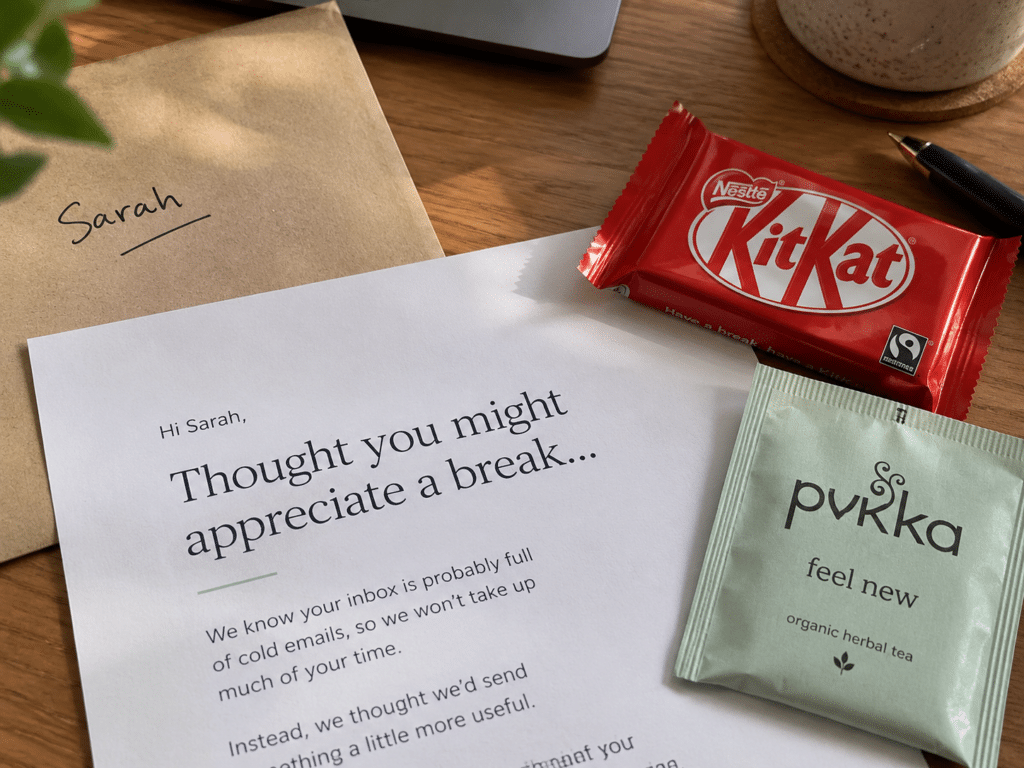
We took a different approach. We sent a small, carefully selected list of prospects (not hundreds, around seventy) a personalised letter. Along with the letter came a KitKat and a tea bag. The line built around it was simple: have a break, have a brew, and give us five minutes to explain why we’re worth talking to.
The cost per piece, including postage, printing and the chocolate, was under £3. The open rate was, effectively, 100%, because the parcel was too interesting to throw away without opening. More importantly, it generated genuine conversations with people who would have deleted a cold email before reading the subject line.
It didn’t close every name on the list. That would be absurd. But it opened doors that no digital channel had managed to, and did so at a cost that made the maths work comfortably even on a handful of conversions.
Where direct mail fits now
This isn’t an argument for abandoning digital. Email, paid social and search advertising all have their place and, when properly managed, deliver strong returns. The point is that direct mail has a specific and underused role: it cuts through when everything else has become noise.
It’s most effective in a few situations:
Hard-to-reach audiences. Senior decision-makers who don’t engage with cold email, whose LinkedIn is managed by an EA, and whose attention is genuinely difficult to buy through paid advertising.
High-value, low-volume prospecting. When you’re targeting fifty or a hundred specific businesses and the margin on a single win justifies serious investment in the approach.
Reinvigorating lapsed relationships. Customers who bought from you two or three years ago and drifted. A physical piece of mail from a business they had a good experience with is far more likely to prompt a response than an automated win-back email they’ve seen from every other brand they’ve ever bought from.
Accompanying a digital campaign. Direct mail used as part of a multi-channel sequence (a letter followed by a phone call followed by an email) consistently outperforms any single channel used in isolation.
What actually makes it work
The most common reason direct mail underperforms is that businesses treat it like a mass leaflet drop. Volume replaces targeting, generic copy replaces personalisation, and the whole thing ends up looking like the pizza delivery menu that falls out of your newspaper.
The campaigns that work share a few things: a tightly defined list of people who have a genuine reason to care about what you’re sending, a clear and specific reason for getting in touch rather than a vague brand awareness play, and something physically interesting enough that it doesn’t go straight in the recycling.
It doesn’t need to be expensive. The KitKat campaign cost under £3 per piece. It needs to be considered.
If you’ve never tested direct mail, or tried it years ago and written it off, the market has changed in your favour. The channel is less crowded than at any point in recent memory, and the businesses willing to use it properly are picking up conversations that everyone else is missing.
Staunton Rook is a full-service marketing agency based in Chester. We plan and execute direct mail campaigns alongside digital marketing programmes for clients across the UK.